Channel Load Planning
Track channel/talkgroup traffic volume over time to identify sustained congestion and overloaded dispatch positions.
Make clearer staffing decisions on when to assign additional dispatchers before service quality degrades.

Transportation
Turn radio traffic into a searchable timeline and investigation-ready record, live and across history.
Rail operations run on radio.
But the operational record is fragmented.
In rail and transit environments, critical decisions move as short transmissions across multiple talkgroups — OCC, control center, field crews, maintenance, train operations.
Voice drives action.
Voice alone does not preserve context.
The result
Slower response in the moment. Less confidence after the fact.
Track channel/talkgroup traffic volume over time to identify sustained congestion and overloaded dispatch positions.
Make clearer staffing decisions on when to assign additional dispatchers before service quality degrades.
Ask questions in chat and retrieve relevant events across channels, time windows, and operational roles.
Example: “Highlight any safety incidents across the transit system over the last 24 hours.”
Automatically highlight safety-related transmissions and escalation patterns across the network.
Focus attention on urgent issues without manually scanning every channel.
Build an exact chronology across any window of time, with click-through to original audio for verification.
Faster investigations, training, and after-action learning.
Generate concise summaries of key communications so incoming teams start with shared context.
Reduce missed details and improve continuity between shifts.
Validate conclusions with one click back to original audio for procurement, compliance, and legal confidence.
Keep summaries useful while preserving verifiable evidence.
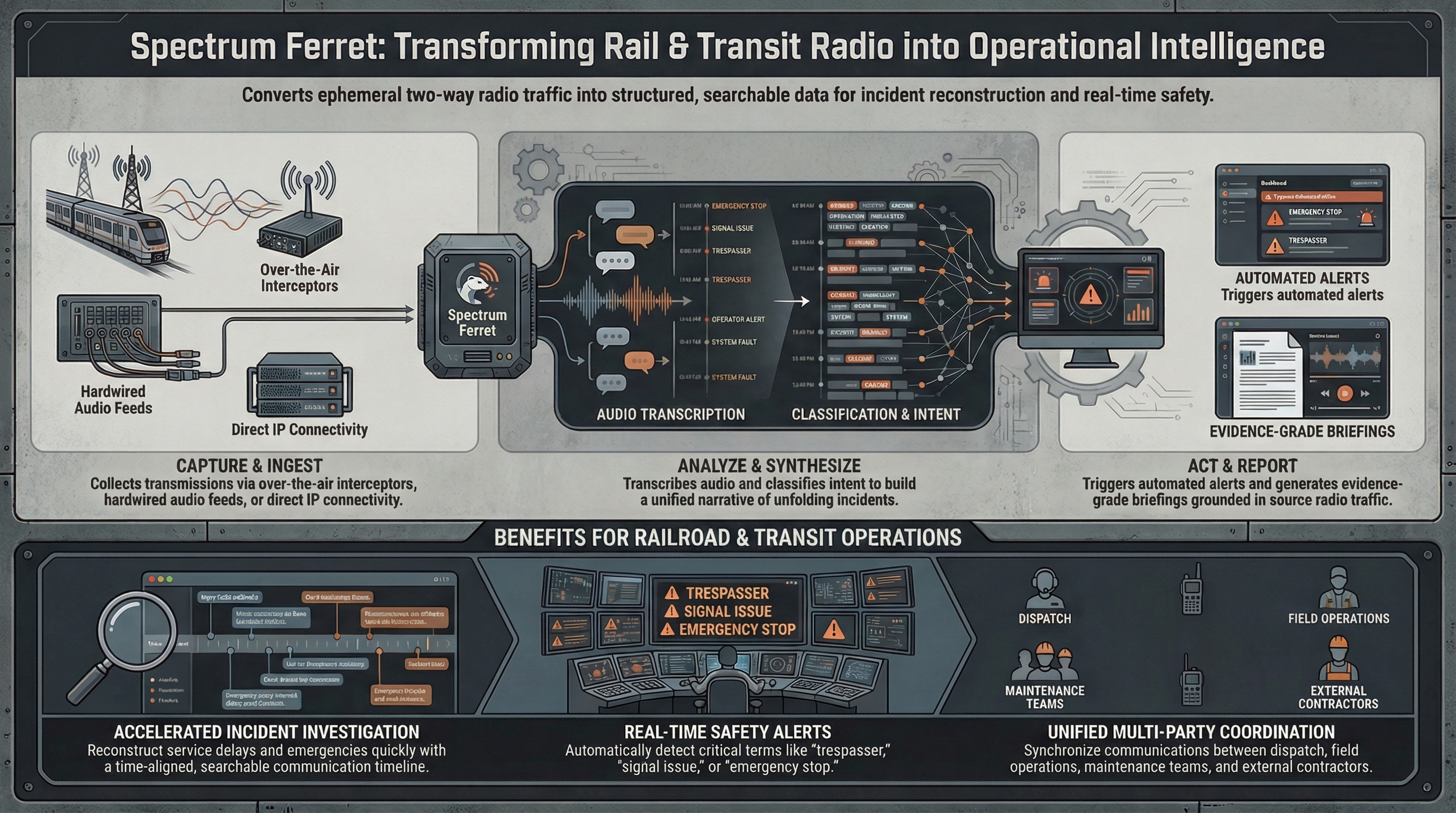
Transportation operations use the same Capture, Analyze, Synthesize, Act workflow shown on the full How it Works page.
1 · Capture
Ingest rail radio traffic from receiver, radio-over-IP, or logging feeds without changing field procedures.
2 · Analyze
Convert transmissions into indexed, searchable context with source-audio traceability.
3 · Synthesize
Merge activity across talkgroups and roles into a coherent, time-aligned operational picture.
4 · Act
Trigger role-routed alerts and produce summaries for shift handoffs and incident review.
See the full workflow details on theHow it Works page.
See how Spectrum Ferret integrates with existing rail radio systems to accelerate investigations, surface real-time safety alerts, and unify operations.
A focused overview of how Spectrum Ferret captures rail radio traffic, surfaces operational risks in real time, and accelerates post-incident reconstruction.
See Real-Time Rail Intelligence
A detailed integration view showing how Spectrum Ferret connects to existing LMR, RoIP, and dispatch systems — transforming voice traffic into searchable, evidence-grade operational intelligence.
View Full Rail Integration Model
Bus bridge, reroutes, platform ops, and communications escalation.
Capture authorization and coordination threads.
Organize communications around outages and restoration workflows.
Keep OCC/ROC, field teams, and public safety aligned during storms, flooding, and heat events.
Preserve a coherent record across roles and channels.
Support faster reconstruction and cross-team alignment.
Accelerate fact-finding with a searchable chronology.
Identify gaps and replay key moments with operational context.
Review simulated incidents end-to-end to improve SOP adherence, training quality, and preparedness.
What teams gain when communications become searchable and verifiable.
A focused pilot can establish immediate operational value with minimal lift.
Pilot shape (example)
Success metrics
Trust
Transportation teams get verifiable records, governance-ready controls, and deployment flexibility that fits existing security architecture.