
Live Incident Awareness
See active traffic in one timeline filtered by channel, unit, incident, and role.
Know what is unfolding without rewinding raw audio.
First Responders
Turn mission-critical radio traffic into searchable context teams can review and share during and after incidents.
Radio is fast.
But context is fragile.
During dynamic incidents, critical details move in short transmissions across channels between dispatch, command staff, field crews, and mutual-aid agencies.
Voice drives response.
Voice alone does not preserve full incident context.
The result
Slower response in the moment. Less confidence after the fact.
See active traffic in one timeline filtered by channel, unit, incident, and role.
Know what is unfolding without rewinding raw audio.
Ask natural-language questions and retrieve relevant events across channels, periods, and agencies.
Example: “Show responder safety events in the last operational period.”
Surface maydays, hazards, and escalation signals quickly so command staff can triage faster.
Configurable, explainable alerting aligned to SOPs.
Reconstruct events across channels and operational periods with click-through to original audio.
Speed debriefs and after-action review with verifiable chronology.
Generate concise summaries for shift changes and command updates with key events and decisions.
Improve continuity and reduce missed context during handoffs.
Validate summaries and conclusions with direct access to original radio audio for accountability.
Preserve trust across command staff, partner agencies, and reviewers.
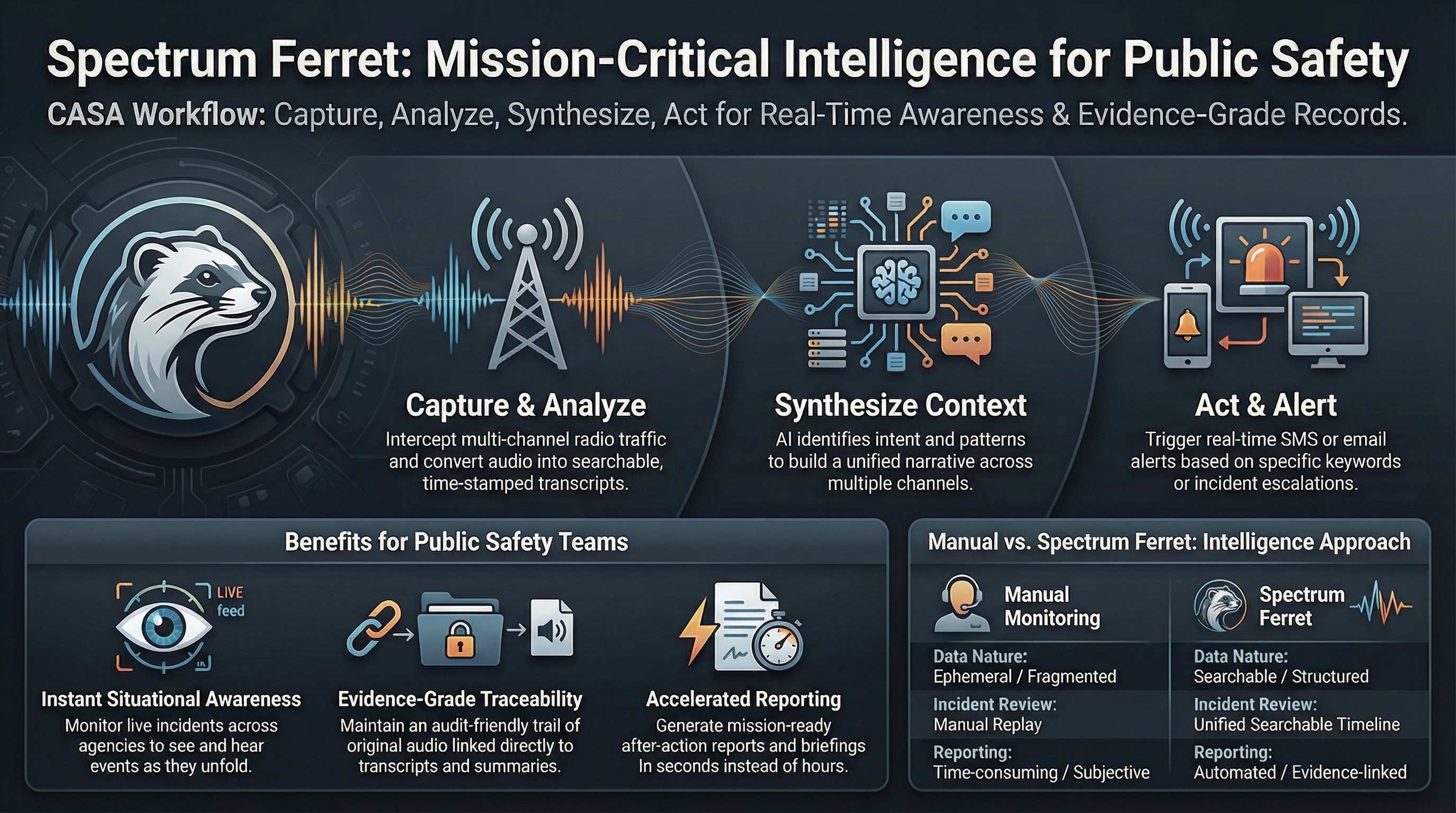
First-responder operations use the same Capture, Analyze, Synthesize, Act workflow shown on the full How it Works page.
1 · Capture
Ingest multi-channel incident traffic from over-the-air, direct audio, or IP feeds without changing radio operations.
2 · Analyze
Convert transmissions into indexed, searchable context with source-audio verification.
3 · Synthesize
Merge activity across channels, units, and periods into one time-aligned operational picture.
4 · Act
Route alerts to the right roles and generate summaries for command updates, handoffs, and review.
See the full workflow details on theHow it Works page.
See how Spectrum Ferret integrates with existing LMR, PoC, and dispatch workflows to accelerate investigations, surface risk in real time, and preserve evidence integrity.
A focused overview of how Spectrum Ferret captures radio traffic, identifies emerging risk signals, and accelerates post-incident review for law enforcement, fire, and EMS.
See Real-Time Public Safety Intelligence
A detailed system view showing how Spectrum Ferret connects to LMR, RoIP, and dispatch systems to create a searchable, evidence-grade communications record.
View Full Public Safety Integration Model
Make better decisions with less friction.
Track hazards, updates, and resource requests across operational periods.
Capture mission-critical details and keep teams aligned.
Keep an auditable, searchable record across channels and partner agencies.
Identify communication gaps and replay key moments with full context.
Hand off the incident story between shifts with confidence.
Accelerate reconstruction and documentation with a searchable, time-aligned chronology.
Trust
First-responder teams get dependable context and accountable records in dynamic, multi-agency radio environments.